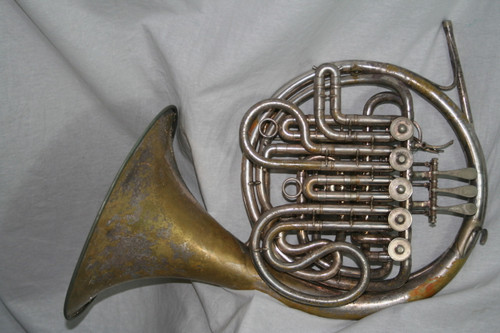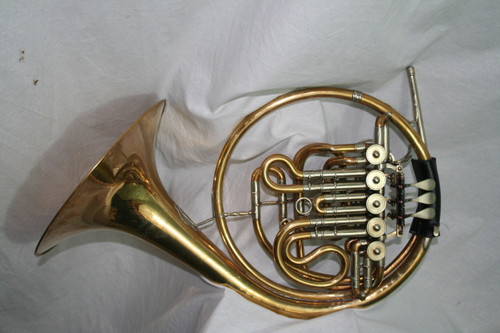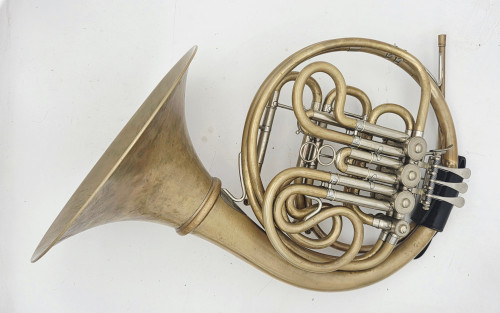
Jacob Medlin studied horn making with Rick Seraphinoff - and his attention to detail is due to his time there. He uses a mix of modern techniques and old school 'art' to create what he calls a horn that plays perfectly in tune. This is an unlacquered yellow brass horn with a detachable flare (Lawson/Alexander ring). The valves have perfect compression (0.1) and a Clebsch strap has been added for comfort. There are 2 Amado waterkeys and there is a brass cap over where there used to be a Joy Key. It's got lots of small dings in the flare (those pesky quick mute changes!!!) but overall it's in fine shape. No need to wait years for your dream horn...it's HERE.
Marcus Bonna MB5 case included.
Here's how Jacob describes his horns:
What my horns will do
In the past, players were forced to choose between horns which favored either the high or low range, or the bright or dark end of the tone color spectrum. Using metallurgical tempering techniques and good architecture design, I have significantly reduced the differences in feel between the octaves, and matched the Bb and F sides much more closely. Additionally, the extremes of the dynamic range from ppp to fff are more controllable with less effort. Regardless of any individual characteristics that a horn of mine might express, you can count on enjoying the following:
Purity of articulation. My horns have just the right amount of resistance to allow for pure articulations. This eliminates the burbles that sometimes occur and even reduces the appearance of spontaneous note chips.
Clarity of sound. Often horns that are clear up close, sound muddy in a hall. This is because different overtones have different projection potential. By maximizing the frequencies that project, and minimizing those which do not, I can give the horn a clear sound for the hall.
Smooth note changes. I've always believed that jobs are won and kept with the beautiful excerpts rather than the technical ones. By removing the bump between notes, the player can focus on the music, and not the technique, for playing lyrically.
Perfect intonation. The tapered sections of the horn correct the intonation issues inherent in a straight pipe. I work on my tapers solely for intonation and control the resistance and character of the horn in other places. This ensures that every note is where it is supposed to be and that chop micromanagement is not necessary to pull notes in tune. This reduces the effort to play the horn and extends endurance and efficiency.